A Single Weekend: Striping a Refrigerated Distribution Center
Project Details:
Contractor: Stewart Richey Construction
Location: Bowling Green, Kentucky
Project Contact: Jimmy Petty
Coating Distributor: HPP Industrial
Refrigerated distribution centers don’t stop moving, product keeps flowing in and out, forklifts keep running staging lanes, and the facility rarely has a window where the floor isn’t in use. So
when a distribution center needed 8,000 linear feet of staging and traffic striping restored, the work had one shot: a single weekend shutdown, with surface and air temperatures sitting at 33°F. That combination, a hard deadline and a coating chemistry’s worst-case temperature, ruled out most conventional striping systems before the crew ever opened a pail.
Most high-performance floor coatings, including standard two-component epoxies, cure through a chemical reaction between mixed components that slows dramatically, or stalls outright, as temperatures drop toward freezing. Applied too cold, a conventional system can stay soft, cure unevenly, or fail to bond — a risk no contractor wants to take on 8,000 feet of safety striping with a hard reopening deadline. Stewart Richey Construction, based in Bowling Green, Kentucky, needed a coating system engineered to perform in exactly these conditions, not in spite of them.
The answer was a single-component, moisture-cure aliphatic urethane (MCU) system from Wasser, supplied through HPP Industrial: MC-Luster 100 in Safety Yellow as the color coat, topped with a clear coat of MC-Clear 100.
Unlike conventional coatings, MCU chemistry cures by reacting with ambient humidity rather than depending on warm temperatures to drive a chemical reaction between two mixed parts; both products are rated for application in temperatures as low as 20°F, with no ice or frost on the substrate, and carry no dew-point restriction beyond requiring avisibly dry surface.
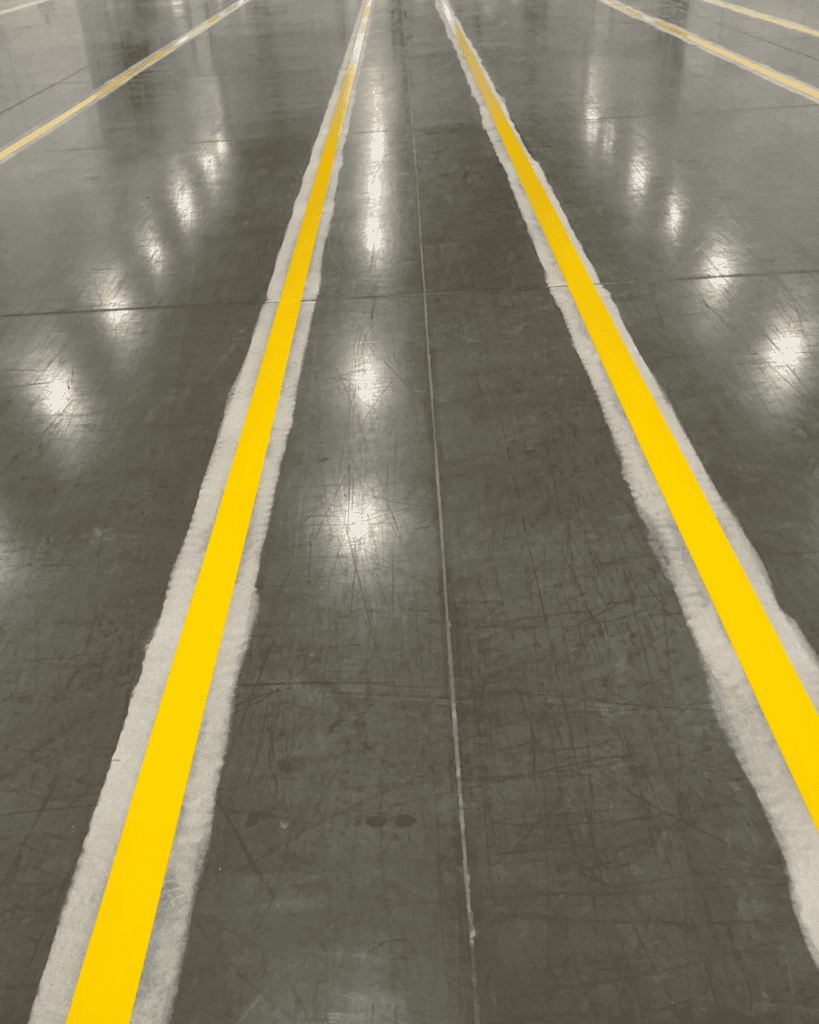
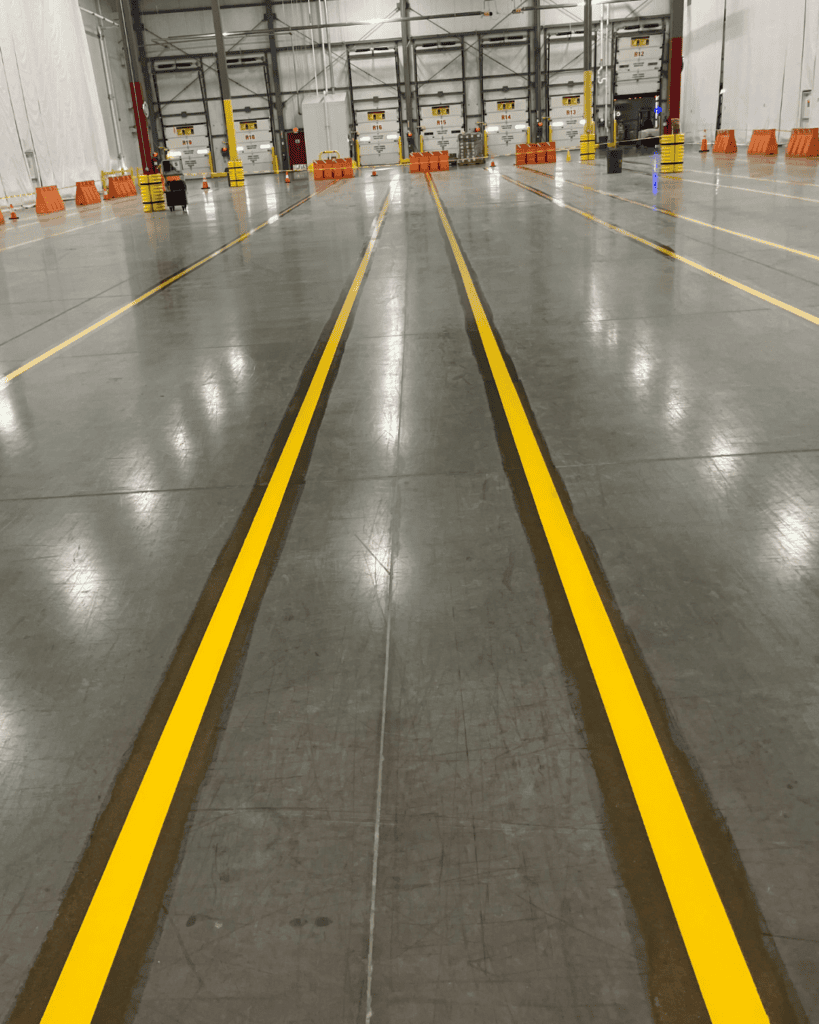
Being single-component also meant no mixing ratios to manage and no pot life to race against — the crew could move continuously across the full 8,000 feet without stopping to remix material, a real advantage inside a fixed shutdown window.
The two-coat system also had to hold up long after the weekend ended. Both MC-Luster 100 and MC-Clear 100 are aliphatic urethanes, meaning they resist the UV-driven yellowing and color fade that can dull safety-yellow striping over time, while standing up to the abrasion, impact and chemical exposure of constant forklift and foot traffic in an active staging area.
By the time the distribution center reopened, all 8,000 feet of striping were down, cured, and ready for traffic; a project that succeeded because the coating chemistry, not just the schedule, was built for the conditions on the ground. It’s a clear example of how HPP Industrial helps contractors like Stewart Richey Construction take on jobs that a standard coating system simply can’t handle: matching the right cold-weather, fast-turnaround chemistry to a deadline that isn’t moving.
Written by Pam Sholtes, President of HPP Industrial